Oct 13, 2026Resources
0.035 vs 0.049 vs 0.065 Tubing Wall Thickness: What Changes?
Compare 0.035, 0.049 and 0.065-inch tubing wall thicknesses. Learn how wall thickness affects pressure, flow and compression fitting compatibility.
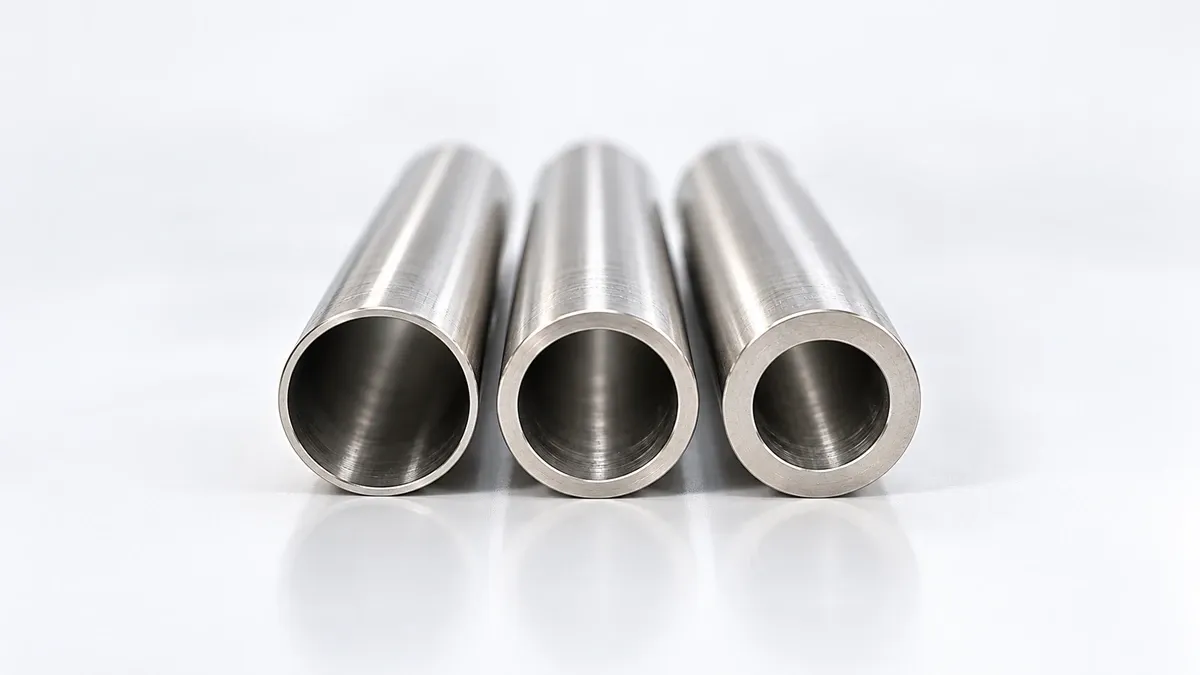
Two stainless steel tubes can have the same outside diameter but very different pressure capabilities.
For example, 1/2-inch OD instrumentation tubing is available in several wall thicknesses, including 0.035, 0.049 and 0.065 inches.
Although these tubes have the same outside diameter, they differ in internal diameter, pressure capability and flow area.
For engineers and industrial buyers, selecting the wrong wall thickness can create problems with pressure requirements, fitting compatibility or system performance.
This article compares these three common tubing specifications and explains what to verify before ordering tubing for high-pressure instrumentation systems.
1. Comparing Three Common Tubing Wall Thicknesses
Consider three tubes with the same nominal outside diameter:
1/2 inch (12.7 mm).
Specification | 0.035" Wall | 0.049" Wall | 0.065" Wall |
|---|---|---|---|
Outside diameter | 0.500" | 0.500" | 0.500" |
Wall thickness | 0.035" | 0.049" | 0.065" |
Wall thickness (mm) | 0.889 | 1.245 | 1.651 |
Calculated inside diameter | 0.430" | 0.402" | 0.370" |
Internal flow area | 0.145 in² | 0.127 in² | 0.108 in² |
Values are calculated from nominal dimensions and do not account for manufacturing tolerances.
The relationship is straightforward:
Inside Diameter = Outside Diameter − 2 × Wall Thickness
As wall thickness increases, the inside diameter decreases.
But what does that mean for actual industrial applications?
2. How Does Wall Thickness Affect Pressure Capability?
For tubing of the same outside diameter, material and manufacturing condition, increasing wall thickness generally increases its ability to withstand internal pressure.
However, the allowable working pressure cannot be determined from wall thickness alone.
It also depends on:
- Material grade and mechanical properties.
- Tubing manufacturing specification.
- Operating temperature.
- Applicable piping design code.
- Manufacturing tolerances.
- Service conditions.
Example: Why 0.035" and 0.065" Are Not Equivalent
A 1/2-inch OD tube with a 0.035-inch wall has less material resisting internal pressure than an otherwise comparable tube with a 0.065-inch wall.
Consequently, the two tubes should not automatically be treated as interchangeable in a pressure-sensitive system.
Published manufacturer tubing tables illustrate these differences.
However, pressure values from another manufacturer's tubing catalog should not be applied directly to a different tubing product or complete fitting assembly.
For purchasing purposes, the correct question is not simply whether thicker tubing is stronger.
It is:
Does this specific tubing and fitting combination meet the required working pressure at the actual operating temperature?
3. Does Thicker Tubing Always Mean a Higher System Pressure Rating?
No.
This is an important distinction when selecting high-pressure instrumentation components.
A tubing system may contain:
- Stainless steel tubing.
- Double-ferrule compression fittings.
- Threaded connectors.
- Instrument valves.
- Pressure gauges.
- Other connected equipment.
Each component has its own operating limitations.
Even if thicker tubing provides a higher allowable pressure, the complete assembly may still be limited by a fitting, valve, threaded connection or instrument port.
Example
Suppose an engineer is considering replacing 0.049-inch-wall tubing with 0.065-inch-wall tubing.
The thicker tube may have a higher pressure capability.
However, that change does not establish that the existing compression fitting, valve or threaded connection is suitable for a higher pressure.
The complete assembly must be evaluated before increasing the system's operating pressure.
4. How Does Wall Thickness Affect Flow?
Increasing wall thickness reduces the inside diameter when the outside diameter remains unchanged.
This also reduces the internal cross-sectional area.
For the three 1/2-inch OD examples:
Wall thickness | Calculated internal area |
|---|---|
0.035" | 0.145 in² |
0.049" | 0.127 in² |
0.065" | 0.108 in² |
Compared with 0.035-inch-wall tubing, the 0.065-inch-wall version has approximately 25% less internal cross-sectional area.
That does not mean the actual flow rate will decrease by exactly 25%.
Flow depends on fluid properties, pressure differential, tubing length, internal diameter and other system components.
Nevertheless, the difference can matter in applications where flow capacity or pressure drop is important.
When should buyers pay particular attention?
Examples include:
- Instrument sampling lines.
- Hydraulic control circuits.
- Gas distribution systems.
- Process measurement connections.
In these applications, choosing tubing solely for its pressure capability may overlook flow requirements.
5. Can All Three Wall Thicknesses Use the Same Double-Ferrule Fitting?
Not automatically.
Double-ferrule compression fittings are designed to grip and seal tubing through controlled ferrule engagement.
Although the three tubes have the same outside diameter, their wall thicknesses affect how the tubing responds during assembly.
Thin-wall tubing
Relatively thin tubing may provide less mechanical support during ferrule engagement.
Depending on the fitting design and tubing material, excessive deformation or insufficient support can affect connection performance.
Thick-wall tubing
Thicker tubing generally provides greater resistance to deformation.
However, this does not mean every fitting design is approved for every thick-wall tubing specification.
The manufacturer's tubing compatibility range must be checked.
What should buyers verify?
Before combining tubing with compression fittings, confirm:
- Tubing outside diameter.
- Tubing wall thickness.
- Tubing material and condition.
- Tubing hardness requirements.
- Fitting manufacturer's compatibility guidance.
- Required operating pressure and temperature.
Do not assume that matching the outside diameter guarantees a suitable connection.
For mixed-brand assemblies, compatibility should be established rather than inferred from similar dimensions.
6. Why Is Tubing Wall Thickness Important for Gas Service?
Gas systems require particular attention to connection integrity.
Unlike many liquid systems, compressed gases can store substantial energy.
Gas leakage may also be more difficult to detect in certain applications.
For compression fittings, suitable tubing dimensions, surface condition and mechanical properties are therefore important.
Some manufacturers distinguish between tubing combinations recommended for general service and those recommended for gas service.
These recommendations depend on the specific tubing material, dimensions and fitting design.
Practical purchasing recommendation
When specifying tubing for nitrogen, hydrogen, compressed air or another gas, include the actual service conditions in the RFQ.
Do not assume that a tubing combination approved for one application is automatically suitable for another.
The gas type, operating pressure, temperature and applicable safety requirements must be considered.
7. What Happens When Operating Temperature Increases?
Tubing pressure capability can change with temperature.
At elevated temperatures, the allowable stress of a material may decrease.
Consequently, a tubing pressure rating established at ambient temperature may require adjustment for higher-temperature operation.
For example, tubing intended for a system operating at 200°C should not automatically be evaluated using only an ambient-temperature pressure rating.
The correct assessment depends on the material specification and applicable design requirements.
Buyers should request pressure-rating information applicable to the actual operating temperature.
The temperature limits of fittings, valves and other connected components must also be considered.
8. Which Wall Thickness Should You Choose?
There is no universal answer.
The appropriate wall thickness depends on the complete application.
The following table summarizes the key considerations.
Wall thickness | Main consideration | What to verify |
|---|---|---|
0.035" | Larger internal passage among the three examples | Whether pressure and fitting requirements are satisfied |
0.049" | Intermediate wall thickness and internal passage | Actual pressure capability and fitting compatibility |
0.065" | Greater wall thickness and smaller internal passage | Whether the thicker wall is appropriate for the fitting and flow requirements |
This comparison is not a pressure-rating chart or a recommendation that any particular wall thickness is suitable for a specified pressure.
Example A: Replacing existing instrumentation tubing
An industrial maintenance buyer needs to replace a damaged 1/2-inch stainless steel tube.
The existing tube has a 0.049-inch wall.
The buyer should not substitute 0.035-inch-wall tubing solely because both products have the same outside diameter.
Before replacement, confirm the original tubing specification, operating conditions and fitting requirements.
Example B: Designing a new high-pressure line
An OEM engineer is designing an instrumentation line and considering 0.049-inch and 0.065-inch wall thicknesses.
The engineer should compare the applicable pressure ratings, internal flow requirements and compression fitting compatibility.
The final selection should satisfy the complete system requirements.
Example C: Purchasing tubing for an existing fitting system
A distributor receives an order for 1/2-inch OD stainless steel tubing without a wall thickness.
Before quoting a substitute, the distributor should request the missing specification.
This reduces the risk of supplying tubing that is dimensionally similar but unsuitable for the customer's existing connection system.
9. What Should Buyers Include in an RFQ?
A complete RFQ helps suppliers identify the required tubing configuration and avoid unsuitable substitutions.
For example:
Parameter | Example specification |
|---|---|
Product | Instrumentation tubing |
Outside diameter | 1/2 inch |
Wall thickness | 0.049 inch |
Material | 316L stainless steel |
Manufacturing standard | Applicable ASTM specification |
Operating pressure | 200 bar |
Operating temperature | 80°C |
Process medium | Nitrogen |
Connection type | Double-ferrule compression fittings |
Quantity | 100 meters |
Documentation | Material certificate, if required |
The example describes information supplied by a buyer. It does not establish that the tubing or fittings are suitable for 200 bar nitrogen service.
For replacement orders, existing part references, tubing markings and drawings can provide useful additional information.
For OEM projects, a complete BOM can help suppliers review the proposed connections.
Frequently Asked Questions
Is 0.065-inch-wall tubing always better than 0.035-inch-wall tubing?
No.
Thicker tubing generally offers greater pressure capability under otherwise comparable conditions, but it also reduces internal diameter.
The selected tubing must satisfy pressure, flow and fitting compatibility requirements.
Can I replace 0.049-inch-wall tubing with 0.065-inch-wall tubing?
Not without verification.
Even when the outside diameter and material are identical, the replacement must be checked against the fitting manufacturer's tubing requirements and the complete system design.
Does tubing wall thickness affect compression fitting performance?
Yes.
Tubing wall thickness and mechanical properties influence the support available during ferrule engagement.
Use tubing within the fitting manufacturer's validated compatibility range.
Is the pressure rating of tubing the same as the pressure rating of the fitting?
Not necessarily.
The tubing and fitting may have different pressure limitations.
The complete connection must be evaluated for the intended service.
What information is most important when ordering high-pressure instrumentation tubing?
Provide the tubing OD, wall thickness, material specification, operating pressure, operating temperature and process medium.
If the tubing will be installed with existing compression fittings, include the fitting details.
Conclusion
The difference between 0.035, 0.049 and 0.065-inch tubing wall thicknesses goes beyond the amount of metal in the tube wall.
For the same outside diameter, wall thickness affects pressure capability, internal flow area and compatibility considerations.
The correct choice depends on the complete system rather than tubing dimensions alone.
For industrial buyers, confirming these requirements before placing an order can reduce specification errors, unnecessary substitutions and installation problems.
Need Help Sourcing Instrumentation Tubing and Fittings?
StarkValve supplies instrumentation tubing, double-ferrule tube fittings and related fluid connection components for industrial applications.
If you are preparing an OEM project, repeat procurement order or replacement specification, send us your tubing dimensions, material requirements and operating conditions.
Our team can review your requirements and discuss available configurations.