Oct 8, 2026Resources
PTFE Hose vs Stainless Steel Corrugated Metal Hose: Which Should You Choose?
Compare PTFE braided and stainless steel corrugated metal hoses by chemical compatibility, pressure, temperature, flexibility, flow and end connections.
Choosing between a PTFE braided hose and a stainless steel corrugated metal hose is not simply a matter of comparing maximum pressure or temperature ratings.
Both constructions can provide flexible fluid connections, but they differ in their fluid-contacting materials, internal geometry, permeation characteristics, bending behavior and suitability for particular operating conditions.
For OEM engineers, system integrators and industrial buyers, selecting the right hose requires evaluating the complete assembly—including its core, reinforcement, end connections and intended service conditions.
This guide explains the key differences and provides a practical selection checklist for industrial equipment, process systems and liquid-cooling applications.
Quick Selection Summary
Consider a PTFE braided hose when chemical compatibility, a suitable internal flow path or flexible equipment routing are important selection priorities.
Consider a stainless steel corrugated metal hose when a metallic fluid barrier, demanding temperature conditions or accommodation of equipment vibration are important.
Neither construction is automatically the better choice. The final decision must account for the actual fluid, operating pressure, temperature, flow requirements, movement and end connections.
1. Understanding the Two Hose Constructions
PTFE Braided Hose
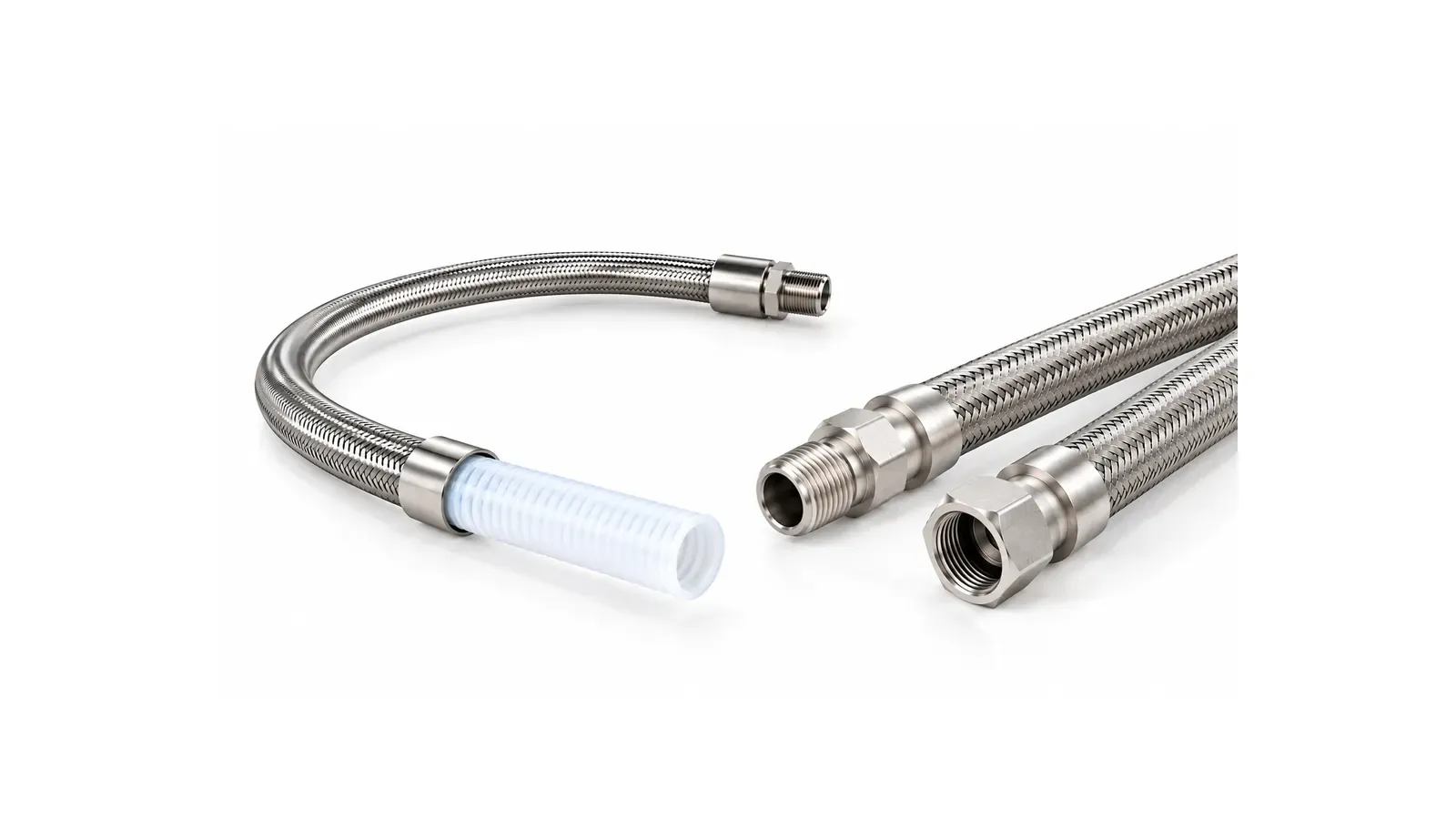
A PTFE braided hose uses a polytetrafluoroethylene (PTFE) core to convey the fluid, with external reinforcement that may include stainless steel wire braid.
PTFE hose constructions are not all identical. Some use a smooth bore, others use a convoluted bore, and certain designs combine a relatively smooth internal flow path with an externally convoluted profile.
The internal geometry matters because it affects flow resistance, flexibility and the potential for fluid retention.
PTFE is widely used for its broad chemical resistance. However, the suitability of a complete hose assembly also depends on its reinforcement, fittings, operating temperature and potential fluid or gas permeation.
Stainless Steel Corrugated Metal Hose
A corrugated metal hose uses a formed metallic tube with corrugations that allow flexibility. The core is commonly made from stainless steel, and an external stainless steel braid may provide pressure reinforcement.
These assemblies are used in industrial systems where a flexible metallic connection is required.
Depending on their construction, metal hoses may accommodate equipment vibration, thermal movement or demanding temperature conditions.
However, corrugations can increase flow resistance, and repeated bending or torsion may shorten service life.
Key distinction: A PTFE hose uses a polymer fluid-contacting core, while a corrugated metal hose uses a metallic core. This difference affects chemical compatibility, permeation, temperature capability and mechanical behavior.
2. PTFE vs Corrugated Metal Hose: Quick Comparison
Selection Factor | PTFE Braided Hose | Stainless Steel Corrugated Metal Hose |
|---|---|---|
Fluid-contacting core | PTFE | Corrugated stainless steel or another specified alloy |
Chemical compatibility | Broad for many chemicals; verify exact fluid conditions | Depends on alloy, fluid chemistry and temperature |
Temperature capability | Depends on liner and complete assembly | May suit more extreme temperatures with appropriate construction |
Internal flow path | Smooth-bore designs may offer lower flow resistance | Corrugations can increase turbulence and pressure loss |
Flexibility | Depends on liner profile, braid and size | Depends on corrugation design, braid and size |
Permeation | May require evaluation, especially for gases | Metallic wall can be advantageous for low-permeation requirements |
Vibration and movement | Requires bend-radius and fatigue assessment | Requires bend-radius, fatigue and torsion assessment |
Typical selection priorities | Chemical resistance, fluid transfer and equipment routing | Metallic containment, temperature and equipment connections |
This table describes general construction characteristics, not guaranteed performance ratings for a particular hose assembly.
For specific configurations, see StarkValve's Smooth Bore Convoluted PTFE Braided Hose Assembly and Stainless Steel Corrugated Metal Hose Assembly product pages.
3. Which Hose Is Better for Chemical Compatibility?
Chemical compatibility should be evaluated using the actual process fluid—not a broad material description.
PTFE Hose
PTFE offers broad resistance to many industrial chemicals and may be suitable for applications involving aggressive or mixed process media.
However, PTFE chemical resistance alone does not establish compatibility for the complete hose assembly.
Other relevant factors include:
- Fluid concentration and chemical formulation
- Operating and cleaning temperatures
- Additives and contaminants
- End-fitting and sealing materials
- Potential permeation through the liner
- Duration and frequency of exposure
For example, water-glycol coolants can contain corrosion inhibitors and other additives. Compatibility should be assessed against the actual formulation rather than assuming that every coolant is suitable.
Corrugated Metal Hose
For metal hose, the selected alloy must be compatible with the process medium.
316L stainless steel is used in many industrial applications, but it is not universally resistant to chloride-containing solutions or aggressive chemicals.
Depending on concentration, temperature and other conditions, localized corrosion mechanisms may need to be considered.
Selection takeaway: PTFE may be preferable for some chemical environments, while stainless steel may be preferable for others. Confirm compatibility for all wetted materials and the complete assembly before specifying either construction.
4. How Do Temperature and Pressure Affect the Choice?
Pressure and temperature ratings must be evaluated together.
Temperature Considerations
PTFE hose temperature capability depends on the liner construction, reinforcement and end-fitting design.
Corrugated metal hose may be considered for particularly low or elevated temperatures, provided the complete assembly is qualified for those conditions.
A material's temperature resistance must not be treated as the allowable operating temperature of every hose made from that material.
Pressure Considerations
The allowable working pressure of a hose assembly depends on several factors:
- Hose diameter
- Core construction
- Reinforcement and braid design
- Operating temperature
- Static or dynamic service
- End-fitting configuration
- Applicable design and test requirements
A published maximum pressure for one configuration cannot be applied to all sizes.
Likewise, burst pressure and proof-test pressure are not interchangeable with allowable working pressure.
What Buyers Should Request
For pressure-sensitive applications, ask for the allowable working pressure of the exact assembly at the intended operating temperature.
Where pressure surges, pulsation or repeated movement occur, include these conditions in the specification.
Selection takeaway: Do not choose a hose solely because its catalog lists a higher maximum pressure or temperature. Verify the actual configuration under the intended operating conditions.
5. Which Hose Offers Better Flow Performance?
Flow performance is particularly important in liquid cooling, chemical transfer and equipment systems where pressure loss affects pump performance.
A suitable smooth-bore PTFE hose can provide a relatively unobstructed internal flow path.
By comparison, the internal corrugations of a metal hose can increase turbulence and pressure loss.
However, this does not mean every PTFE hose has lower pressure loss than every metal hose.
The actual result depends on:
- Internal diameter
- Hose length
- Flow rate
- Fluid viscosity and density
- Internal corrugation geometry
- Number and severity of bends
- End-fitting bore restrictions
A smaller smooth-bore hose may produce more pressure loss than a larger corrugated hose under certain operating conditions.
For flow-sensitive applications, request pressure-drop information at the intended flow rate.
Selection takeaway: Compare complete flow paths and actual operating conditions, not just the nominal hose diameter or core material.
6. What About Bending, Vibration and Repeated Movement?
Flexibility is one of the main reasons to use a hose assembly instead of rigid tubing or piping.
However, a hose that bends easily during installation is not necessarily suitable for continuous movement.
PTFE Hose
PTFE hose flexibility varies with the liner profile, reinforcement and diameter.
Some convoluted constructions are designed to improve routing flexibility, but minimum bend-radius limits still apply.
Corrugated Metal Hose
Corrugated metal hose may be used to accommodate limited movement, vibration or thermal displacement.
Nevertheless, repeated flexing can produce fatigue stresses in the metal corrugations.
Twisting the hose along its longitudinal axis can also reduce service life.
Important Installation Factors
For either construction, verify:
- Minimum static bend radius
- Dynamic bend radius, if applicable
- Required live length
- Movement direction and amplitude
- Vibration frequency
- Installation orientation
- Support and restraint requirements
- Risk of torsional loading
Selection takeaway: Provide the expected movement and installation geometry when requesting a hose assembly. A configuration suitable for static service may not be suitable for continuous flexing.
7. Which Hose Should You Consider for Liquid Cooling?
Liquid-cooling systems contain multiple connection points with different requirements.
A hose suitable for one location in a cooling loop may not be suitable for another.
Rack-Level and Equipment Cooling Connections
Where space is limited and routing is complex, an appropriately selected PTFE hose may be considered when its coolant compatibility, bend characteristics and assembly performance meet the system requirements.
Other hose materials, including EPDM and thermoplastics, are also used in liquid-cooling applications.
A stainless steel braid alone does not establish suitability for rack-level cooling.
CDU, Pump and Chiller Connections
Corrugated metal hose may be considered for selected coolant distribution unit (CDU), pump, chiller and facility-side connections.
A metallic construction or the need to accommodate equipment vibration may influence the selection.
PTFE hose may also be suitable for some of these connections.
The final decision depends on system design and verified assembly performance.
What Should Liquid-Cooling Buyers Verify?
Before specifying a hose, confirm:
- Coolant type, glycol concentration and additives
- Required flow rate and allowable pressure drop
- Normal and maximum operating pressure
- Pressure transients
- Fluid and ambient temperatures
- Cleanliness and flushing requirements
- Hose routing and expected movement
- Leakage acceptance criteria
- End-connection and quick-disconnect requirements
Selection takeaway: Select a hose according to its position in the cooling system and the actual duty conditions. Neither PTFE nor corrugated metal hose is the universal solution for every liquid-cooling application.
8. What About Gas, Vacuum and Low-Permeation Applications?
For some gas and vacuum systems, containment performance may be more important than routing flexibility.
PTFE is not an absolute gas barrier. Depending on the gas, pressure, temperature and liner construction, permeation may need to be evaluated.
A metallic hose wall can be advantageous where low permeation is important.
However, the leak-tightness of a metal hose assembly also depends on its welds, end connections and manufacturing quality.
Vacuum suitability must be assessed separately.
A hose designed for internal pressure should not automatically be assumed suitable for full vacuum or external-pressure loading.
Selection takeaway: For gas or vacuum service, specify the operating medium, pressure or vacuum level, required leak-tightness and applicable test requirements.
9. Can the Same End Connections Be Used?
Both PTFE and corrugated metal hose assemblies may be available with different equipment-side connection styles.
Depending on the product and manufacturer, these may include:
- NPT threaded connections
- BSP threaded connections
- JIC flare connections
- Union connections
- Flanges
- Other application-specific interfaces
However, the equipment-side connection and hose-side attachment are two different parts of the assembly design.
A fitting intended for a conventional hydraulic hose cannot automatically be used with a PTFE or corrugated metal hose.
PTFE assemblies require attachment methods compatible with the particular liner and reinforcement construction.
Corrugated metal hose assemblies commonly use specially engineered metallic end attachments, including welded connections.
Even when two assemblies have the same nominal thread size, their sealing geometry may differ.
Selection takeaway: Specify the exact connection standard, size, sealing arrangement and compatible hose-side attachment. Do not assume interchangeability based on thread names alone.
10. Common Hose Selection Mistakes
Choosing by Maximum Pressure Alone
A maximum published pressure may apply only to certain diameters or operating conditions.
Better approach: Confirm the allowable working pressure for the exact assembly and intended temperature.
Ignoring Pressure Drop
A hose may satisfy the pressure rating but restrict the required process or coolant flow.
Better approach: Evaluate internal diameter, flow rate, length, bends and end-fitting restrictions.
Assuming All Stainless Steel Is Chemically Resistant
Different stainless steel grades have different corrosion limitations.
Better approach: Verify alloy suitability against the actual process medium and temperature.
Treating PTFE as Completely Impermeable
Some fluids or gases may permeate through a PTFE liner.
Better approach: Assess permeation requirements where relevant.
Ignoring Dynamic Movement
Repeated bending, vibration and torsion can reduce hose service life.
Better approach: Provide installation geometry and movement details before selecting the assembly.
Selecting End Fittings by Thread Name Alone
Matching thread names do not guarantee a compatible seal or hose attachment.
Better approach: Confirm the complete end-connection specification.
Confusing Material Limits with Assembly Ratings
A liner or alloy may tolerate conditions that the finished hose assembly cannot.
Better approach: Use verified ratings for the complete assembly.
11. What Information Should You Include in a Hose Assembly RFQ?
A clear RFQ helps suppliers evaluate the application, identify suitable configurations and avoid unnecessary clarification cycles.
RFQ Item | Information to Provide |
|---|---|
Hose type | PTFE braided or corrugated metal, if already specified |
Internal diameter | Required bore size and dimensional constraints |
Assembly length | Overall length and measurement convention |
Operating medium | Exact fluid or gas, concentration and additives |
Pressure | Normal pressure, maximum pressure and possible surges |
Temperature | Minimum, normal and maximum operating temperatures |
Flow requirements | Required flow rate and allowable pressure drop |
Movement | Static, vibrating or repeatedly flexing |
End A / End B | Connection type, size, gender and sealing configuration |
Materials | Required wetted materials and corrosion constraints |
Testing | Pressure, leakage, cleanliness or other specified tests |
Documentation | Drawings, inspection records or other required documents |
Quantity | Prototype quantity, batch quantity and anticipated repeat demand |
For replacement assemblies, include photographs, drawings or the original part number when available.
For new OEM designs, an installation sketch showing routing, movement and available space can help identify potential fitment issues.
Procurement tip: If the application requirements are known but the hose construction is undecided, provide the operating conditions and ask for a configuration review rather than specifying a material prematurely.
12. How to Make the Final Choice
Consider a PTFE braided hose when the application prioritizes broad chemical resistance, an appropriate internal flow path or flexible routing, provided the selected assembly meets the required pressure, temperature and permeation conditions.
Consider a stainless steel corrugated metal hose when the application favors a metallic fluid barrier, demanding temperature conditions or accommodation of equipment vibration, provided the assembly is suitable for the required pressure, bending and fatigue conditions.
If both constructions appear suitable, compare their verified performance under the actual operating conditions.
For critical systems, also consider inspection requirements, installation constraints, replacement frequency and total lifecycle cost.
The best hose is not necessarily the one with the highest catalog rating. It is the complete assembly that reliably meets the application's requirements.
Explore Related StarkValve Products
Smooth Bore Convoluted PTFE Braided Hose Assembly
A PTFE-core flexible hose construction with stainless steel braid for application-specific industrial fluid connections.
View PTFE Braided Hose Assembly — link to the corresponding StarkValve product detail page.
Stainless Steel Corrugated Metal Hose Assembly
A corrugated stainless steel hose construction with external braid for industrial flexible connections.
View Corrugated Metal Hose Assembly — link to the corresponding StarkValve product detail page.
Need Help Specifying a Hose Assembly?
Share your operating medium, pressure, temperature, hose size, end connections, required quantity and any available drawings or BOM.
StarkValve can review available configurations, clarify technical requirements and confirm quotation and documentation options.