Oct 5, 2026Resources
How to Choose Instrumentation Tube Fittings
Learn how to select instrumentation tube fittings by tube OD, connection type, thread, material, tubing, pressure, temperature and service conditions.
Choosing an instrumentation tube fitting involves more than matching the tube outside diameter.
A fitting that appears to be the correct size can still be unsuitable if the connection type, tubing, material, pressure, temperature, process media, or installation conditions are not considered together.
For instrumentation, process control, hydraulic, testing, sampling, and other fluid systems, a more reliable approach is to work through the application step by step.
This guide explains what engineers and buyers should confirm before selecting or requesting a quotation for instrumentation tube fittings.
Instrumentation Tube Fitting Selection Checklist
Before selecting a fitting, confirm the following:
Selection Factor | What to Confirm |
|---|---|
Tube size | Actual tube outside diameter (OD) |
Unit system | Inch or metric tubing |
Fitting function | Straight connection, direction change, branch, reduction, bulkhead connection, etc. |
End connection | Tube end, male thread, female thread, or another required interface |
Thread standard | NPT, BSPP, BSPT, or other specified thread |
Material | Based on tubing, process media, environment, temperature, and corrosion conditions |
Tubing | Material, OD, wall thickness, condition, and surface quality |
Pressure | Maximum working pressure and relevant operating conditions |
Temperature | Minimum and maximum operating temperature |
Media | Liquid or gas, chemical composition, and compatibility requirements |
Environment | Indoor, outdoor, marine, corrosive, vibration, thermal cycling, etc. |
Documentation | Drawings, material documentation, testing, inspection, or other project requirements |
If several of these items are unknown, clarify them before finalizing the fitting specification.
1. Start With the Tube OD — Not Just “1/2 Inch”
One of the easiest ways to specify the wrong fitting is to provide only a nominal size such as:
“I need a 1/2-inch fitting.”
That is not enough information.
A 1/2-inch tube OD, a 1/2-inch nominal pipe size, and a 1/2-inch threaded connection describe different dimensions.
Instrumentation tube fittings are selected according to the actual outside diameter of the tubing at the tube end. Therefore, first confirm:
- What is the tube OD?
- Is the tubing inch or metric?
- What is the tube wall thickness?
The tube OD determines the tube-end size. Wall thickness is then checked as part of tubing suitability, pressure capability, and compatibility with the fitting system.
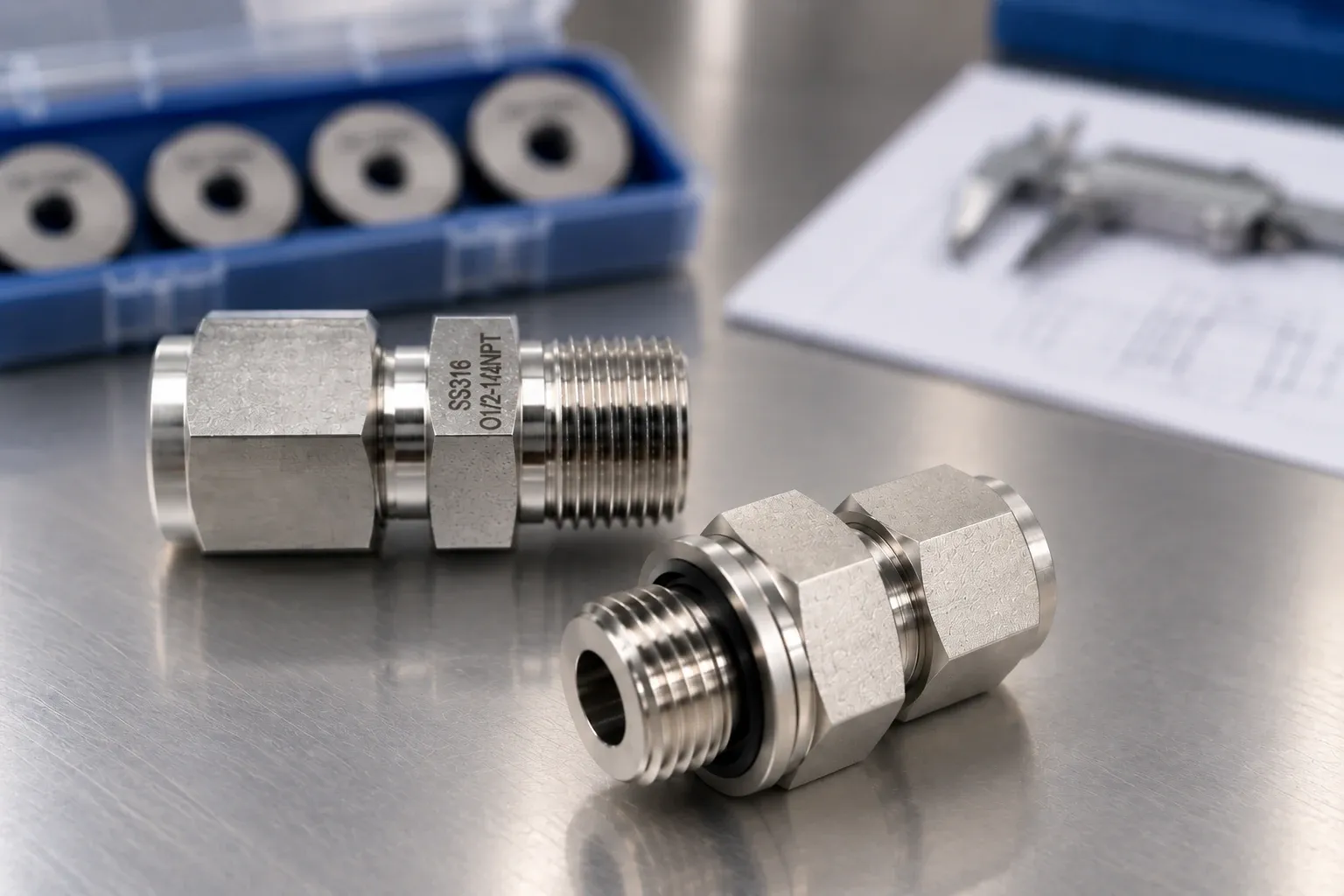
For example, a fitting may connect 1/2 in OD tubing to a 1/4 in male NPT port. These two dimensions describe different interfaces on the same fitting.
This distinction becomes especially important when reviewing BOMs that contain both tube sizes and thread sizes.
2. Define What the Fitting Needs to Do
Once the tubing size is known, determine the function of the fitting in the system.
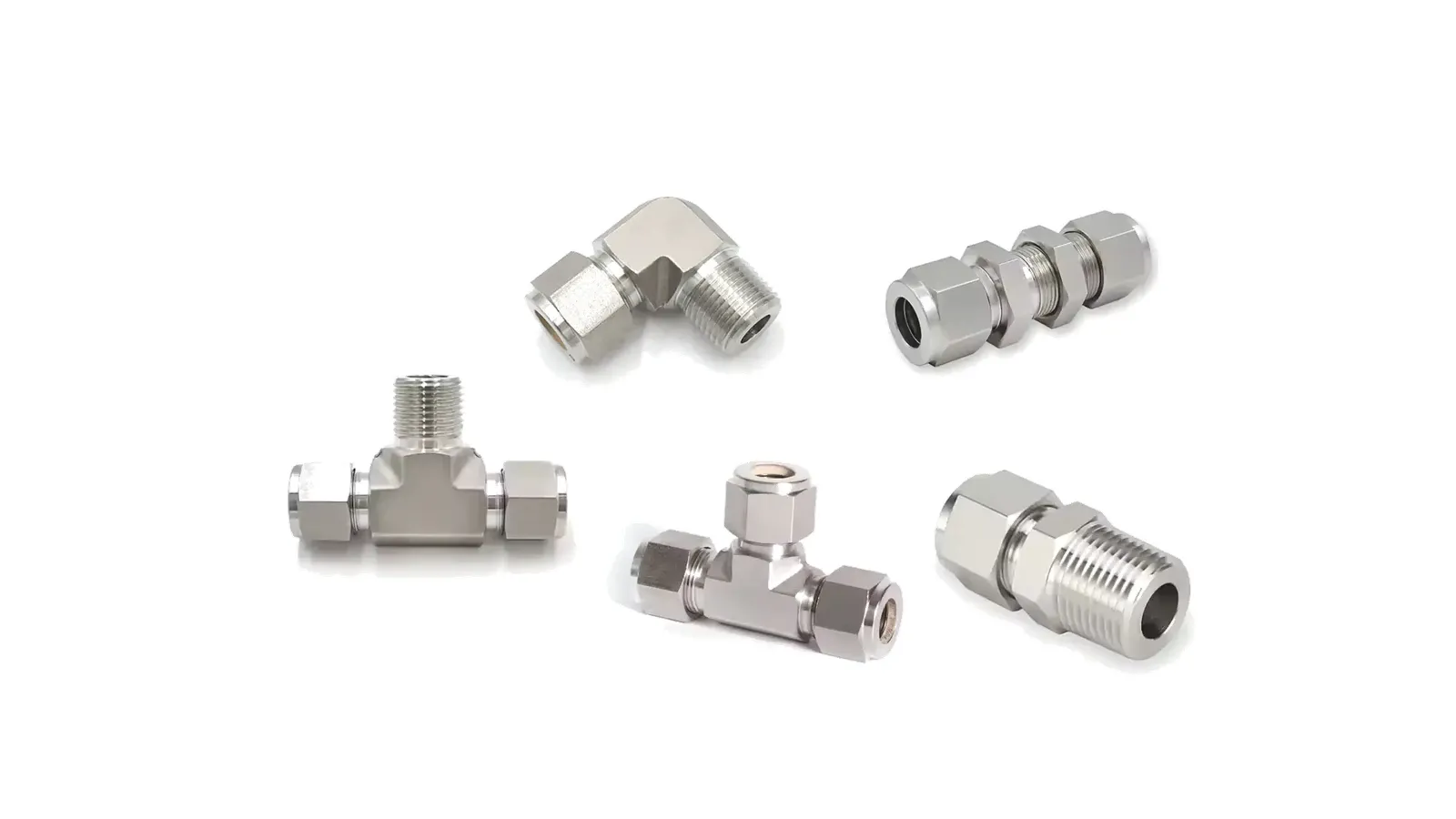
Connector
A connector transitions between tubing and another connection, commonly a threaded port.
Typical applications include connecting tubing to:
- valves;
- pressure gauges;
- pressure transmitters;
- manifolds;
- regulators;
- instrument ports; and
- process equipment.
Depending on the system interface, a male or female threaded connector may be required.
Union
A union connects two sections of tubing.
A straight union provides an in-line tube-to-tube connection, while a reducing union can connect different tube sizes where the design requires it.
Elbow
An elbow changes the direction of the tubing run.
It can be useful where equipment layout, available space, or tubing routing makes a directional fitting more practical than additional tube bending.
Tee
A tee creates a branch in the tubing system.
Typical uses include instrument branches, sampling lines, pressure measurement points, and other circuits requiring a branch connection.
Bulkhead Fitting
A bulkhead configuration allows a tube connection to pass through a panel, enclosure, cabinet, or similar barrier.
The fitting configuration should follow the actual function of the connection—not simply which component appears to have the right size.
3. Confirm Every End Connection
A tube fitting can contain more than one type of interface.
For example:
Tube OD × Male NPT
is different from:
Tube OD × Female NPT
and both are different from:
Tube OD × Tube OD
Before ordering, identify every connection point on the component.
For threaded ends, confirm:
- male or female;
- thread size;
- thread standard;
- tapered or parallel thread; and
- intended sealing method.
Do not assume that two threads are compatible simply because their nominal sizes appear similar.
NPT, BSPP, and BSPT differ in thread geometry and/or sealing method. Incorrect identification can lead to poor engagement, damaged threads, or leakage.
If the thread cannot be identified confidently, provide a drawing, equipment specification, existing part information, or clear dimensional details before ordering.
4. Treat the Tubing and Fitting as One Connection System
A reliable tube connection depends on more than the fitting itself.
The tubing is part of the connection system.
When evaluating tubing for an instrumentation tube fitting, important factors can include:
- tubing material;
- actual outside diameter;
- wall thickness;
- hardness or condition where applicable;
- seamless or welded construction where specified;
- surface condition; and
- applicable tubing specification.
Tubing wall thickness is particularly important when evaluating pressure capability and suitability for the fitting system.
Surface Condition Matters
Mechanical tube fittings grip and seal on the tube OD. Scratches, surface defects, excessive ovality, burrs, or unsuitable weld-related surface conditions can interfere with proper assembly or sealing.
This deserves additional attention in demanding gas service, where very small leak paths may become significant.
A high-quality fitting cannot compensate for unsuitable or damaged tubing in every situation.
5. Select Material From the Service Conditions — Not From Habit
316 stainless steel is widely used in industrial instrumentation systems, but material selection should still begin with the application.
Consider:
- process fluid;
- fluid concentration where relevant;
- operating temperature;
- external environment;
- chloride exposure;
- corrosion risk;
- tubing material;
- cleaning or process requirements; and
- applicable project specifications.
Using a more corrosion-resistant alloy is not automatically necessary for every application. Conversely, selecting 316 stainless steel simply because it is familiar may not be appropriate for every aggressive environment.
Material selection should answer two separate questions:
1. Is the material suitable for the process media?
2. Is the material suitable for the external operating environment?
These are not always the same problem.
Compatibility between the fitting and tubing materials also requires attention. Arbitrarily mixing dissimilar materials can introduce concerns related to mechanical compatibility or galvanic corrosion.
For corrosive, high-temperature, or unusual service, provide the actual media and operating conditions when requesting a material recommendation rather than selecting an alloy based only on a generic material name.
6. Do Not Select Pressure Capability From the Fitting Size Alone
A common RFQ question is:
“Is this fitting suitable for my working pressure?”
The answer should not be determined from fitting size alone.
The connection must be evaluated as a system.
Relevant variables can include:
- fitting design;
- fitting material;
- tubing material;
- tube OD;
- tube wall thickness;
- end connection;
- operating temperature;
- installation; and
- applicable manufacturer ratings.
Tubing wall thickness is particularly important because tubing pressure capability varies with size, material, and wall thickness.
In addition, another end connection—such as a threaded port—may become the limiting component in the complete connection.
This is why an RFQ that says only:
“1/2-inch stainless steel fitting, high pressure”
does not provide enough information for a responsible selection.
Provide the actual tube dimensions and operating conditions whenever pressure capability needs to be verified.
7. Consider Pressure and Temperature Together
Pressure should not be evaluated independently of temperature.
Material properties and allowable working conditions can change as temperature changes, and elevated-temperature service may require pressure derating.
For an RFQ, provide:
- normal operating temperature;
- maximum operating temperature;
- minimum operating temperature where relevant; and
- significant thermal cycling, if present.
Do not assume that a pressure rating established under one temperature condition automatically applies across the full operating temperature range.
The final allowable working conditions should be verified against the applicable product and tubing data for the actual configuration.
8. Identify the Process Media
The process media can influence both material selection and connection requirements.
At minimum, identify whether the system carries:
- liquid;
- gas; or
- a specific chemical/process medium.
Where relevant, also provide concentration, contamination sensitivity, purity requirements, or other process information that could affect material or sealing decisions.
Gas Service Deserves Additional Attention
Gas systems can be less tolerant of very small leak paths than many liquid systems.
For gas service, tubing surface condition, wall thickness, dimensional quality, fitting selection, and correct installation therefore deserve particular attention.
If leakage could have important safety, purity, environmental, or process consequences, clearly identify the gas and service conditions in the RFQ.
Do not leave the supplier to infer the media from the part number.
9. Consider the Installation Environment
Two systems using the same tube size and nominal pressure may still require different connection decisions.
Ask whether the installation will experience:
- vibration;
- repeated thermal cycling;
- equipment movement;
- difficult access;
- corrosive external exposure;
- frequent maintenance;
- confined installation space; or
- other demanding operating conditions.
For example, a connection installed near vibrating machinery requires greater attention to tubing routing, support, and overall system layout than the same fitting installed on a stable instrument panel.
Likewise, limited installation space may influence whether a straight connector, elbow, or bulkhead configuration is more practical.
The correct fitting is the one that suits the complete connection and operating environment—not simply the one with the fewest components.
10. Avoid These Common Tube Fitting Selection Mistakes
Mistake 1: Providing Only a Nominal Size
“1/2 inch” does not tell the supplier whether the dimension refers to tube OD, nominal pipe size, or thread size.
Mistake 2: Identifying Threads by Appearance Alone
Similar-looking threaded connections are not necessarily interchangeable.
Mistake 3: Ignoring Tubing Wall Thickness
Tube OD determines the tube-end size, but OD alone does not fully define the tubing or its pressure capability.
Mistake 4: Selecting 316 Stainless Steel Automatically
316 stainless steel is suitable for many industrial applications, but material selection should reflect the actual process media and operating environment.
Mistake 5: Specifying Pressure Without Temperature
Pressure and temperature need to be evaluated together.
Mistake 6: Ignoring Tubing Condition
The fitting grips and seals on the tubing. Tubing dimensions, wall thickness, surface condition, and other relevant properties can directly affect connection performance.
Mistake 7: Sending an Ambiguous BOM
A description such as:
“Connector, SS316, 1/2 × 1/4, Qty 100”
still leaves important questions unanswered.
Which dimension is the tube OD? Which is the thread? Is the thread male or female? Is it NPT, BSPP, BSPT, or another standard?
Clear specifications reduce quotation errors before they become purchasing errors.
A Better Way to Specify an Instrumentation Tube Fitting
A useful RFQ can follow this format:
Fitting type: Male Connector
Tube OD: 1/2 in
Thread: 1/4 in Male NPT
Material: 316 Stainless Steel
Tubing: 316 Stainless Steel, wall thickness specified
Maximum working pressure: [Required Value]
Operating temperature: [Required Range]
Process media: [Liquid / Gas / Chemical]
Quantity: [Required Quantity]
Documentation / testing: [If Required]
If you already have a BOM or drawing, include it with the operating conditions.
For replacement projects, an existing part number can also be useful, but it should not replace verification of the actual size, connection, material, and service requirements.
Instrumentation Tube Fitting Selection: A Simple Decision Path
1. Identify the tube OD and inch/metric system
↓
2. Define the fitting function — connector, union, elbow, tee, bulkhead, reducer, etc.
↓
3. Identify every end connection
↓
4. Confirm the thread standard and sealing method where applicable
↓
5. Confirm tubing material, wall thickness, condition, and surface quality
↓
6. Select fitting material for the process and environment
↓
7. Verify pressure and temperature requirements
↓
8. Check media, corrosion, vibration, and other service conditions
↓
9. Confirm documentation and testing requirements
↓
10. Finalize the part specification and quantity
If a critical step is unknown, resolve it before ordering rather than guessing from the nearest-looking part number.
Frequently Asked Questions
Is Tube Size the Same as Pipe Size?
No. Instrumentation tubing is commonly specified by actual outside diameter, while pipe uses a nominal sizing system. Thread size is another separate dimension. Always identify what each dimension in an RFQ represents.
Can I Select a Tube Fitting Based Only on Tube OD?
Usually not. Tube OD determines the tube-end size, but fitting configuration, tubing wall thickness and material, thread or other end connection, pressure, temperature, media, and service conditions may also affect final selection.
Does a 1/2 in Tube Fitting Necessarily Have a 1/2 in Thread?
No. A connector can join one tube size to a completely different threaded connection. Each end should be specified separately.
Can NPT, BSPP, and BSPT Threads Be Used Interchangeably?
They should not be assumed to be interchangeable. Their thread geometry and/or sealing methods differ. Identify the actual thread standard and sealing arrangement before ordering.
Does Thicker Tubing Always Mean a Higher Allowable System Pressure?
Not as a universal rule for a completed connection. Tube material, OD, wall thickness, temperature, fitting limitations, and other connection components all matter. Use verified pressure data for the actual tube-and-fitting system rather than assuming suitability from wall thickness alone.
Why Does Tubing Surface Quality Matter?
Mechanical tube fittings grip and seal on the tube OD. Scratches, excessive ovality, burrs, and other surface or dimensional defects can interfere with assembly or create potential leak paths.
What Information Should I Send for a Quotation?
At minimum, provide the fitting type, tube OD, end connection or thread, material, and quantity.
For applications where operating conditions affect selection, also provide the tubing details, working pressure, temperature range, process media, environment, and any testing or documentation requirements.
A drawing or BOM is particularly useful for multi-item or non-standard requirements.
Final Selection Should Be Based on the Complete Application
The most important principle is simple:
Do not select an instrumentation tube fitting as an isolated component.
The fitting, tubing, connection geometry, material, pressure, temperature, process media, environment, and installation conditions form a complete connection system.
For straightforward requirements, a clearly specified tube OD, fitting configuration, end connection, material, and quantity may be enough to identify the appropriate product.
For higher-pressure, corrosive, gas, elevated-temperature, special-alloy, or otherwise demanding service, provide the operating conditions and tubing details before final selection.
Send StarkValve your BOM, drawing, existing part reference, or tube and connection details together with the required material, pressure, temperature, process media, and quantity. We can review the specification before quotation.