Sep 18, 2026Applications
Instrumentation & Process Control
Explore fluid connection, isolation and control requirements for instrumentation lines, measurement loops and process instrument interfaces.
-
- Test access
Different measurement arrangements require different manifold functions.
For this reason, selecting a manifold only as “2-valve,” “3-valve” or “5-valve” does not fully define the requirement. The instrument type, flow path and required operating functions should be considered first.
This is particularly important when the manifold forms part of a pressure or differential-pressure measurement arrangement.
INSTRUMENT — The Measurement Interface
The final section of the fluid path connects the process-side components to the measurement device.
Depending on the system, this may involve a pressure gauge, transmitter, analyzer, test instrument or another measurement interface.
The instrument port and the upstream tubing system may not use the same connection.
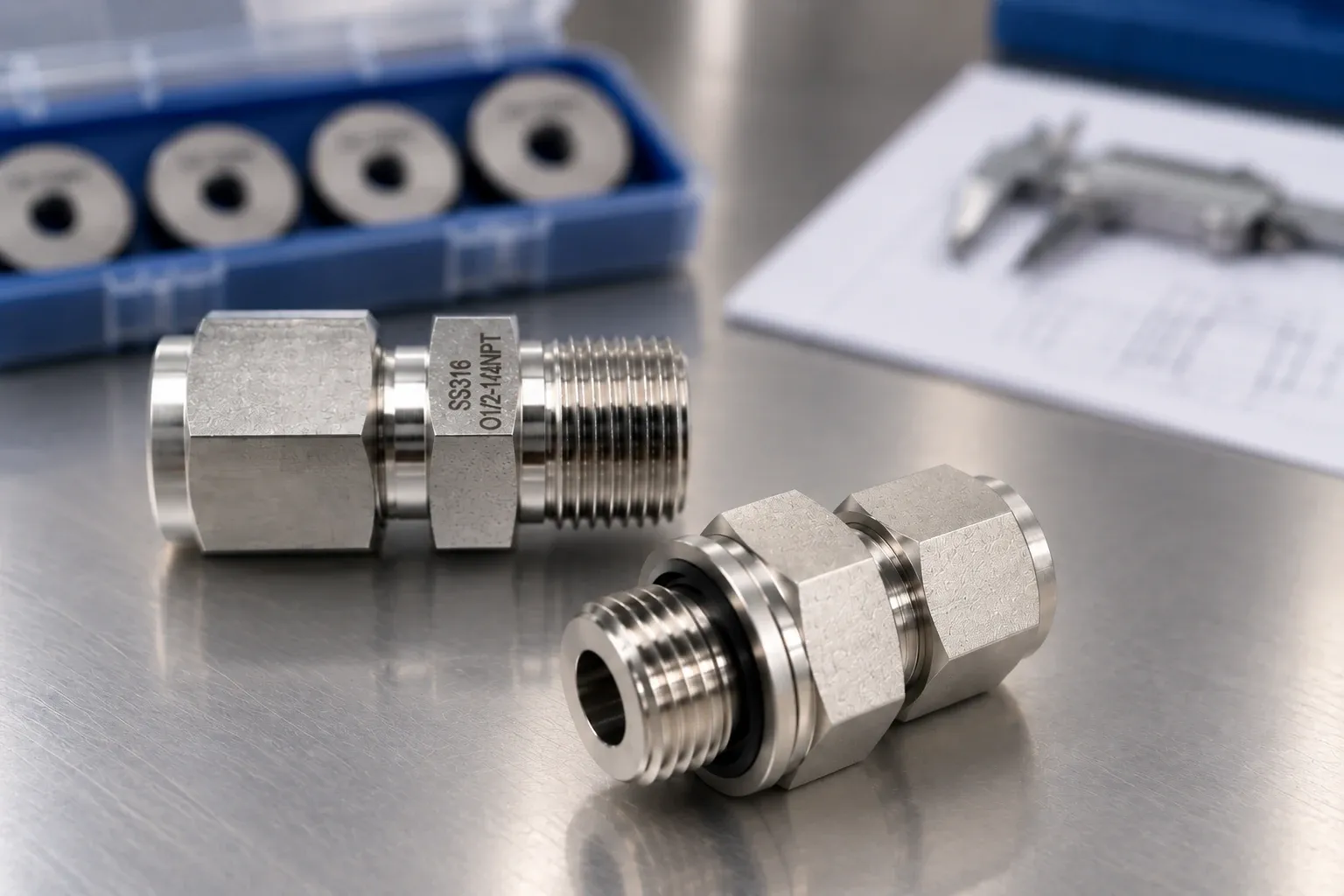
Where adapters or transition fittings are required, identify both interfaces completely:
connection standard + size + male/female configuration + sealing method
This reduces the risk of selecting components that appear similar but use different connection geometries.
Tubing Is Part of the Connection System
Instrumentation tubing carries the fluid between connection, isolation and measurement points.
It should be considered together with the fittings and operating conditions around it.
Relevant specification inputs can include:
- Outside diameter
- Wall thickness
- Material grade
- Pressure
- Temperature
- Process medium
- Routing and bending requirements
- Environmental conditions
- Applicable project specifications
The suitability of a tubing and fitting combination depends on more than nominal size.
For procurement purposes, “316 stainless steel tubing” may therefore be only the beginning of the specification.
Where Specification Problems Commonly Begin
Many instrumentation RFQs are delayed not because the component is unusual, but because a critical interface or operating condition is missing.
Common examples include:
“1/2-inch fitting”
Does not establish whether the size refers to tube OD, pipe thread or another interface.
“Stainless steel valve”
Does not establish valve function, material grade, connection, pressure, temperature or sealing requirements.
“Same as existing part”
An existing manufacturer and complete part number can help identify the component, but the required service conditions and interfaces should still be confirmed.
Pressure without temperature
Operating pressure should not be separated from temperature and the specific component design.
Unknown thread type
Visual similarity is not enough to establish a thread standard or sealing method.
What to Include in an Instrumentation RFQ
A useful instrumentation RFQ should provide as much of the following information as available:
- Application or instrument function Pressure measurement, differential-pressure measurement, sampling, isolation, test connection or another function.
- Required component Tube fitting, valve, manifold, tubing, adapter or flexible connection.
- Connection details Tube OD, thread standard, size, male/female configuration and sealing interface where applicable.
- Material Required grade where specified.
- Operating pressure
- Operating temperature
- Process medium
- Quantity
- Required standards or documentation
- Drawing or existing part number Useful when reviewing a replacement requirement.
If a parameter is unknown, identify it as to be confirmed rather than assuming the specification.
Relevant Component Families
Instrumentation and control systems may use several StarkValve component families:
- Instrumentation Tube Fittings
- Instrumentation Valves & Manifolds
- Instrumentation Tubing
- Pipe Fittings
- Related adapters and transition connections
- Hose & Flexible Connections where required by the system
The appropriate combination depends on the fluid path, instrument arrangement and operating conditions.
Start With the System Requirement
For a new instrument line, begin with the measurement or control function and work through the connection path.
For an existing installation, provide the manufacturer and complete part number where available, together with connection details and operating conditions.
For project requirements, P&IDs, drawings, datasheets or marked-up component lists can provide useful context.
Start with the system requirement. Then narrow the component selection.