Oct 16, 2026Resources
Ball Valve vs Needle Valve: Which One Should You Use?
Compare ball valves and needle valves for isolation and flow adjustment. Learn how operation, flow, pressure, temperature, media and connections affect valve selection.
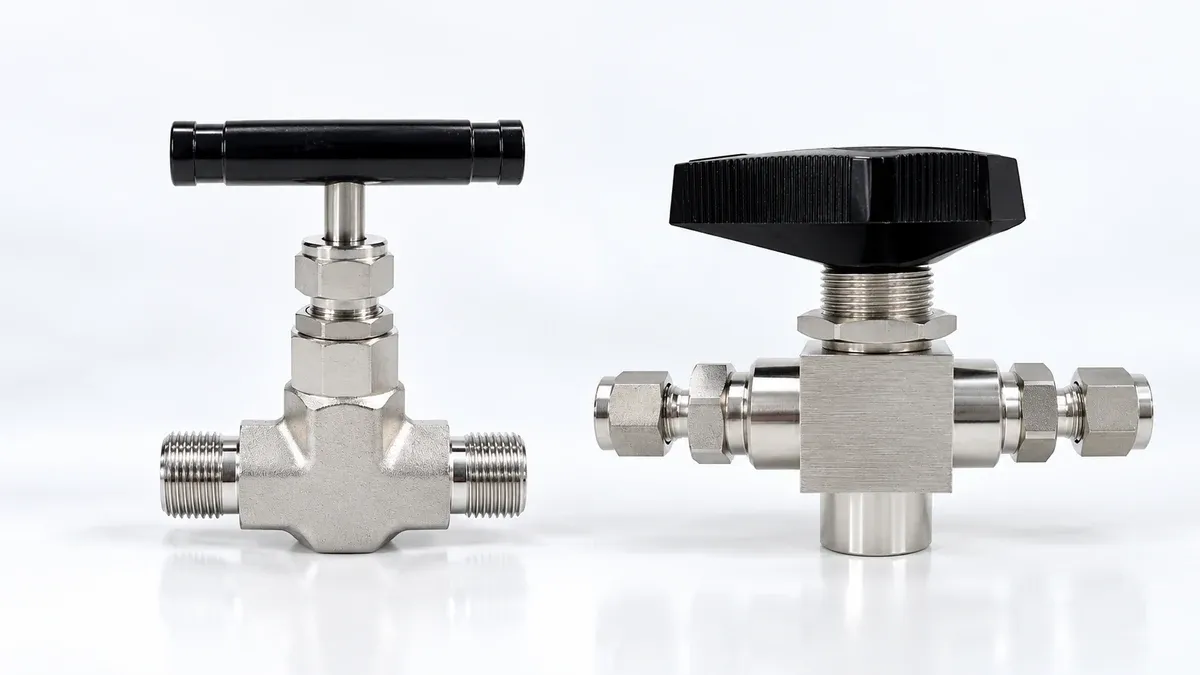
Ball valves and needle valves can both stop flow, but they are designed around different operating needs.
A ball valve is typically the better starting point when you need fast on/off isolation. A needle valve is typically the better starting point when you need gradual adjustment of a small flow.
That sounds simple, but real valve selection also depends on pressure, temperature, media, flow requirements, connection type, materials and how the valve will actually be operated.
This guide explains the differences that matter when specifying valves for instrumentation and industrial fluid systems.
1. Ball Valve vs Needle Valve: What Is the Main Difference?
The fundamental difference is how the valve changes the flow path.
A ball valve uses a ball with a bore through it. Rotating the ball approximately 90° moves the valve between open and closed positions.
A needle valve uses a tapered stem that moves gradually toward or away from a seat as the handle is turned. The multi-turn movement allows smaller changes in the flow opening.
That leads to the most useful rule of thumb:
Requirement | Usually evaluate first |
|---|---|
Fast on/off isolation | Ball valve |
Gradual flow adjustment | Needle valve |
Lower restriction when fully open | Ball valve, depending on bore design |
Small-flow throttling | Needle valve |
Quick visual indication of open/closed position | Lever-operated ball valve |
Both isolation and controlled adjustment | Consider separate functions rather than forcing one valve to do both |
This is a functional comparison, not a pressure or temperature rating table. Actual performance depends on the specific valve design.
2. When Should You Choose a Needle Valve?
Choose a needle valve when the application needs the flow path to change gradually rather than suddenly.
The tapered stem and multi-turn operation allow the opening to be adjusted progressively.
Typical applications may include:
- Instrument lines
- Sampling lines
- Test equipment
- Calibration systems
- Gauge connections
- Small hydraulic or pneumatic control lines
- Other low-flow services requiring manual adjustment
Example: a sampling line
Suppose an operator needs to introduce process fluid into a sampling system.
A simple quarter-turn valve may move from closed to a relatively large opening very quickly. A needle valve allows the operator to increase the opening more gradually.
But there is an important distinction:
A standard needle valve is not automatically a precision metering valve.
If your process requires a defined and repeatable flow rate, you need verified flow data for the actual valve rather than assuming that a particular number of handle turns equals a particular flow rate.
3. When Should You Choose a Ball Valve?
Choose a ball valve when the primary requirement is quick, straightforward isolation.
A typical manually operated ball valve moves between open and closed with approximately a quarter turn.
This provides two useful characteristics:
Fast operation.
The operator does not need multiple handle turns to isolate the line.
Clear valve position.
With many lever-operated designs, handle position provides an immediate visual indication of whether the valve is open or closed.
Ball valves are therefore commonly considered for:
- Equipment isolation
- On/off fluid service
- Test-system switching
- Utility lines
- Applications requiring frequent manual opening and closing
- Systems where a less restrictive open flow path is important
Ball-valve designs vary, however. Do not assume that every ball valve is full-port or has the same pressure drop.
4. Can You Use a Ball Valve for Flow Control?
A conventional ball valve can physically be left partly open, but that does not make it the preferred valve for controlled throttling.
At partial opening, the relationship between handle position and flow is generally much less suitable for fine manual adjustment than the progressive stem movement of a needle valve.
Depending on valve design and service conditions, prolonged throttling can also expose the ball and seats to concentrated velocity, pressure drop and wear.
Therefore:
If the requirement is normal on/off isolation → start with a ball valve.
If the requirement is controlled small-flow adjustment → start with a needle valve.
If accurate flow regulation is critical, go one step further and evaluate the valve using verified Cv or other flow-performance data.
Current industry comparison literature consistently makes this functional distinction between quarter-turn isolation and multi-turn throttling. Parflow Engineering
5. Which Valve Has Better Flow Capacity?
Do not compare flow capacity from the connection size alone.
Two valves can both have 1/2-inch connections while having very different internal flow passages.
A needle valve intentionally introduces a restricted and adjustable flow area around the stem and seat.
A ball valve can provide a more direct flow path when fully open, although the actual restriction depends on whether the particular design is full-port, reduced-port or another configuration.
So:
Same connection size does not mean same flow capacity.
If pressure drop or flow rate matters, request the Cv or applicable flow data for the actual valve configuration.
This is especially important for:
- Purging
- Flushing
- Gas distribution
- Test systems
- Higher-flow equipment connections
6. Is a Needle Valve Always Rated for Higher Pressure?
No.
This is a common purchasing mistake.
You cannot determine the pressure rating from the words needle valve or ball valve alone.
Pressure capability can depend on:
- Body construction
- Valve size
- Body material
- Stem or ball design
- Seat and packing materials
- End connections
- Operating temperature
- Specific product series
High-pressure versions exist in both valve families.
Therefore, do not select a valve by assuming:
Needle valve = high pressure Ball valve = lower pressure
Instead, compare the working-pressure rating of the actual configuration at the required operating conditions.
This is one reason this article deliberately does not reproduce generic 3,000 psi, 6,000 psi or 10,000 psi figures from another manufacturer's catalog. Those values cannot be treated as StarkValve ratings.
7. How Does Temperature Affect Ball Valve vs Needle Valve Selection?
Temperature affects more than the metal valve body.
Depending on the valve construction, temperature limits may be influenced by:
- Seats
- Packing
- Stem seals
- Other sealing materials
- Body and internal materials
This can be particularly important when comparing a soft-seated ball valve with a needle-valve design using a different sealing arrangement.
But the correct conclusion is not:
Needle valves are always better at high temperature.
The correct approach is:
- Define the minimum and maximum operating temperatures.
- Identify the complete valve construction.
- Check the applicable pressure-temperature limits.
- Confirm compatibility with the process media.
A valve's maximum pressure rating at one temperature should not automatically be assumed to apply across its full temperature range.
8. How Does the Process Media Affect the Choice?
Valve selection must consider every relevant wetted material—not only the body material.
Depending on the design, process media may contact:
- Body
- Ball or stem
- Seat
- Packing
- Seals
- Other internal components
For example, specifying:
“316 stainless steel valve”
does not by itself prove compatibility with every chemical, gas or operating temperature.
For corrosive, reactive or otherwise demanding media, provide the supplier with:
- Fluid or gas
- Concentration, where relevant
- Operating pressure
- Operating temperature
- External environment, where relevant
- Required material specification
Material compatibility should then be evaluated for the complete valve configuration.
9. What Connection Type Do You Need?
Choosing the valve function and choosing the connection are two separate decisions.
Depending on the actual product series, instrumentation valves may use configurations such as threaded or tube-end connections.
Threaded connections
Specify the exact thread standard and size.
For example, simply writing:
“1/2 thread”
is not enough.
NPT, BSPP and BSPT have different thread and sealing characteristics and should not be treated as interchangeable descriptions.
If you are unsure which thread you have, identify it before ordering rather than forcing apparently similar threads together.
Tube connections
For a tube-end configuration, specify the tubing OD and confirm compatibility with the applicable tube-fitting system and tubing specification.
The important sequence is:
Choose what the valve needs to do first. Then choose how it connects to the system.
Do not choose a needle valve or ball valve simply because one happens to be available with the required thread.
10. Ball Valve or Needle Valve for Instrumentation?
There is no single answer for every instrument hookup.
Ask what the valve at that particular position must accomplish.
Consider a needle valve when:
- Gradual manual flow adjustment is required.
- A small flow needs to be throttled.
- Controlled introduction of fluid is useful.
- The application is compatible with the specific needle-valve design.
Consider a ball valve when:
- Fast isolation is the main requirement.
- Frequent on/off operation is expected.
- Clear manual position indication is useful.
- Lower flow restriction is important and supported by the selected valve design.
What if you need both?
Sometimes isolation and flow adjustment are separate functions.
In that case, trying to make one valve perform both jobs may not be the best system design.
A system may instead use separate valves for isolation and adjustment, depending on the application.
This distinction also appears in current instrumentation-valve guidance: when both functions are needed, separate isolation and regulation functions can be preferable to repeatedly using one valve for both. Superlok North America
11. A Practical Selection Checklist
Before sending an RFQ, answer these questions.
Step 1 — What must the valve do?
- On/off isolation?
- Gradual flow adjustment?
- Switching?
- Another specific function?
Step 2 — What is the required flow?
If flow capacity or pressure drop matters, provide the required flow conditions and request applicable flow data.
Step 3 — What are the operating conditions?
Provide:
- Maximum operating pressure
- Minimum and maximum operating temperature
- Process media
Step 4 — What are the connections?
Specify:
- Connection type
- Connection size
- Thread standard, if threaded
- Tube OD, if tube connected
Step 5 — What materials are required?
Specify the required body material and any project-specific material requirements.
For demanding media, confirm wetted-material compatibility rather than relying only on the body material name.
Step 6 — Are testing or documents required?
State requirements such as material documentation, inspection or testing when they apply to the project.
Do not assume that a particular certificate or test is included unless it has been confirmed for the order.
12. Quick Decision Table
Your requirement | Start by evaluating | Why |
|---|---|---|
Fast manual isolation | Ball valve | Quarter-turn operation |
Gradual small-flow adjustment | Needle valve | Progressive multi-turn opening |
Frequent on/off operation | Ball valve | Designed around quick opening/closing |
Sampling flow adjustment | Needle valve | More gradual control |
Lower restriction when open | Ball valve | Often provides a more direct flow path; verify actual bore/Cv |
Precise specified flow rate | Verify a suitable metering/control solution | Valve type alone does not establish flow accuracy |
High-pressure service | Either, depending on design | Verify actual configuration rating |
High-temperature service | Either, depending on construction | Verify pressure-temperature limits and sealing materials |
Unknown thread | Neither until identified | Confirm connection before ordering |
13. Common Specification Mistakes
Mistake 1: Selecting only by pressure rating
A valve can meet the pressure requirement and still be wrong for the required function, media, temperature or flow.
Mistake 2: Assuming every ball valve is full-port
Ball-valve internal bore designs vary. Check the actual product.
Mistake 3: Using connection size as a flow specification
A 1/2-inch connection does not tell you the valve's Cv or internal passage size.
Mistake 4: Treating a standard needle valve as a calibrated metering device
Fine adjustment capability does not automatically mean a known, repeatable flow rate.
Mistake 5: Specifying only “stainless steel”
The exact alloy and relevant wetted/sealing materials may matter.
Mistake 6: Ignoring the thread standard
NPT, BSPP and BSPT should not be treated as interchangeable simply because their nominal sizes appear similar.
Frequently Asked Questions
Can a needle valve be used for shutoff?
A suitable needle valve can provide shutoff as well as flow adjustment. Whether it meets the required shutoff performance must be verified for the specific design and operating conditions.
Can a ball valve be used for throttling?
A ball valve can be physically operated at an intermediate position, but a conventional ball valve is generally selected for on/off service rather than fine throttling. If controlled flow adjustment is required, evaluate a needle valve or another purpose-designed control solution.
Which has less pressure drop: a ball valve or a needle valve?
A ball valve often has the less restrictive fully open flow path, but actual pressure drop depends on the specific bore, geometry and flow coefficient. Compare verified flow data rather than valve type alone.
Is a needle valve better for high pressure?
Not automatically. Both needle and ball valves are available in different pressure classes and constructions. Verify the working-pressure rating of the actual valve configuration.
Which valve is better for gas service?
Neither type is automatically correct for every gas application. Selection depends on pressure, temperature, required function, materials, sealing design and the specific gas.
What information should I send when requesting a valve quotation?
At minimum, provide the required function, connection type and size, pressure, temperature, media, material and quantity. Include drawings, an existing part number or a BOM when replacing an existing component.
Conclusion
The most useful difference between a ball valve and a needle valve is functional:
Choose a ball valve when the main requirement is fast on/off isolation.
Choose a needle valve when the main requirement is gradual adjustment of a small flow.
Then verify the decision against the actual pressure, temperature, media, flow requirement, materials and connection configuration.
The valve type is only the beginning of the specification—not the complete specification.
Need Help Selecting a Valve Configuration?
If you are comparing needle valves and ball valves for an instrumentation or industrial fluid system, send StarkValve:
- Required valve function
- Connection type and size
- Operating pressure
- Operating temperature
- Process media
- Required material
- Quantity
- Existing part number, drawing or BOM, if available